Theme 1
Introduction
Introduction about Nikhef as a partnership between NWO-I and six universities.
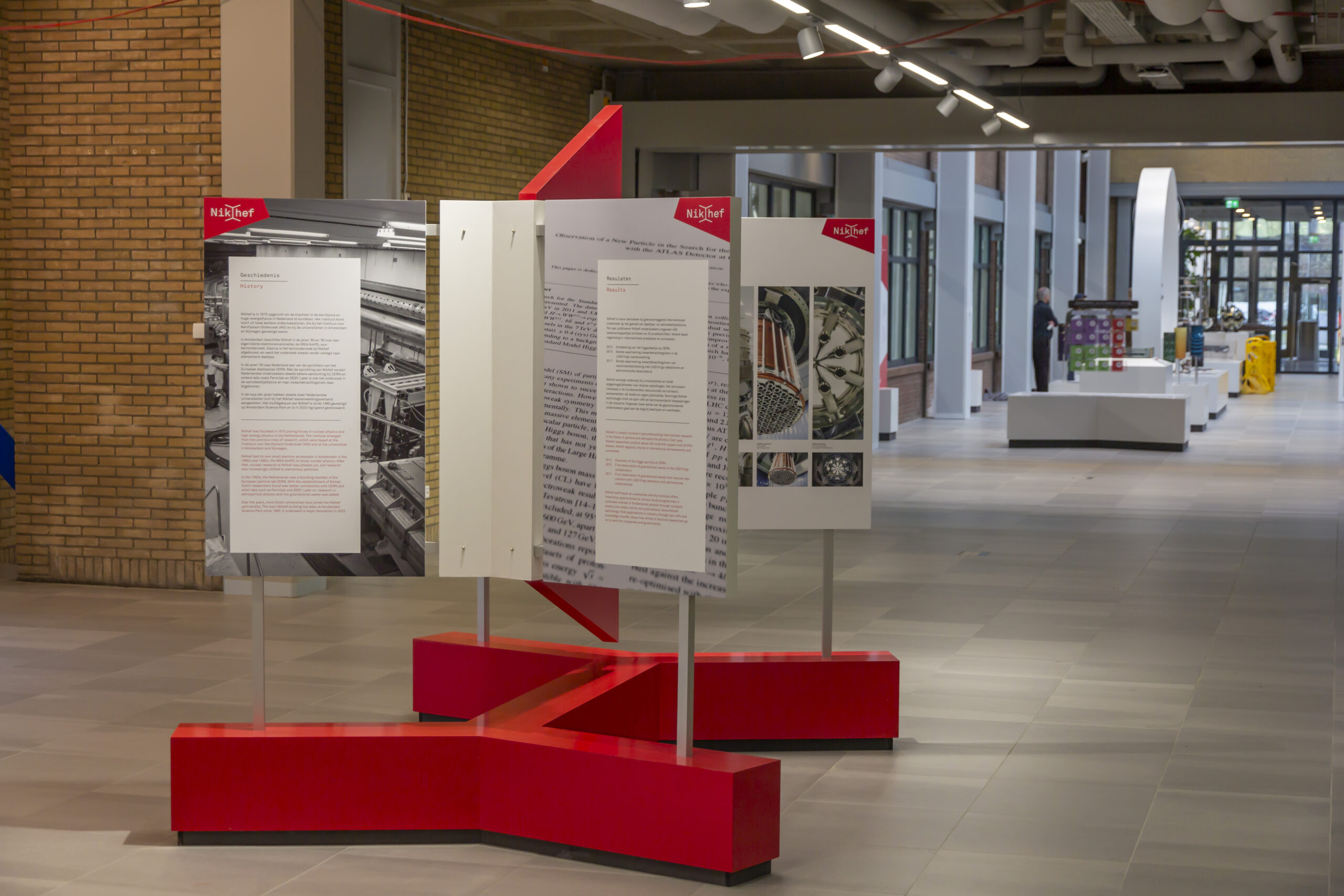
Nikhef is the national institute for subatomic physics, a partnership between NWO-I and six Dutch universities. Information on theory and experiment, as well as engineering. Societal impact, highlights of particle and astroparticle physics, and the history of Nikhef.
About Nikhef
As the National Institute for Subatomic Physics, Nikhef investigates the elementary building blocks of matter and the universe, their mutual forces and the structure of space and time.
Nikhef has 11 research programmes, from theory and experiments to technical programmes, and has its own technical department with labs and workshops. Since 2026, Nikhef also has an Artificial Intelligence theme group.
Nikhef collaborates worldwide in large experiments in particle and astroparticle physics.
Organisation and Partnership
Nikhef employs more than 450 people, from about 60 countries, including approximately:
- Scientific staff: 105
- Technicians: 90
- PhD candidates: 135
- Postdocs: 55
- Support staff: 55
- Director: Prof. Jorgen D’Hondt
(As per June 2026)
Nikhef is a partnership between the Institutes Organisation of NWO (NWO-I) and six Dutch universities.
Theory and Experiment
Nikhef’s research takes place in experiments at particle accelerators such as the Large Hadron Collider (LHC) at CERN near Geneva and with detectors for cosmic rays, neutrinos, dark matter, gravitational waves and special electron properties.
The experimental lines of research go hand in hand with theoretical research, pioneering R&D for future detectors and the development of powerful computational methods and data processing.
Technology
Nikhef has three in-house technical departments for Mechanical Technology, Electronics Technology and Computer Technology. They develop, design and build components and systems that are essential for the experiments Nikhef participates in. The institute has large workshops and labs in Amsterdam for the technical work.
Research in particle and astroparticle physics is always at the frontier of what is technically feasible. Nikhef technicians and engineers are therefore experienced in state-of-the-art techniques and work closely with industrial partners to learn and to share their own knowledge.
History
Nikhef was founded in 1975 joining forces in nuclear physics and high-energy physics in the Netherlands. The institute emerged from two previous lines of research, which were based at the ‘Instituut voor Kernfysisch Onderzoek’ (IKO) and at the universities in Amsterdam and Nijmegen.
Nikhef had its own small electron accelerator in Amsterdam in the 1980s and 1990s, the MEA/AmPS, to study nuclear physics. After that, nuclear research at Nikhef was phased out, and research was increasingly shifted to elementary particles.
In the 1950s, the Netherlands was a founding member of the European particle lab CERN. With the establishment of Nikhef, Dutch researchers found ever better connections with CERN and other labs such as Fermilab and DESY. Later on, research in astroparticle physics and into gravitational waves was added.
Over the years, more Dutch universities have joined the Nikhef partnership. The main Nikhef building has been at Amsterdam Science Park since 1980. It underwent a major renovation in 2023.
Results
Nikhef is closely involved in groundbreaking international research in the fields of particle and astroparticle physics. Each year, Nikhef researchers publish about 450 scientific papers and 20 PhD theses. Nikhef regularly shares in international achievements and successes.
2012 – Discovery of the Higgs particle at CERN
2015 – First observation of gravitational waves in the LIGO/Virgo collaboration
2017 – First observation of gravitational waves from neutron star collision with LIGO/Virgo detectors and astronomical observatories
2025 – Observation of most energetic particle ever
Nikhef staff teach at universities and the institute offers internship opportunities for various study programmes. It promotes interest in fundamental physics through outreach, events, the media and its own publications. Some Nikhef technology finds applications in industry through spin-offs and knowledge transfer. About two-thirds of doctoral researchers go on to work for companies and governments.
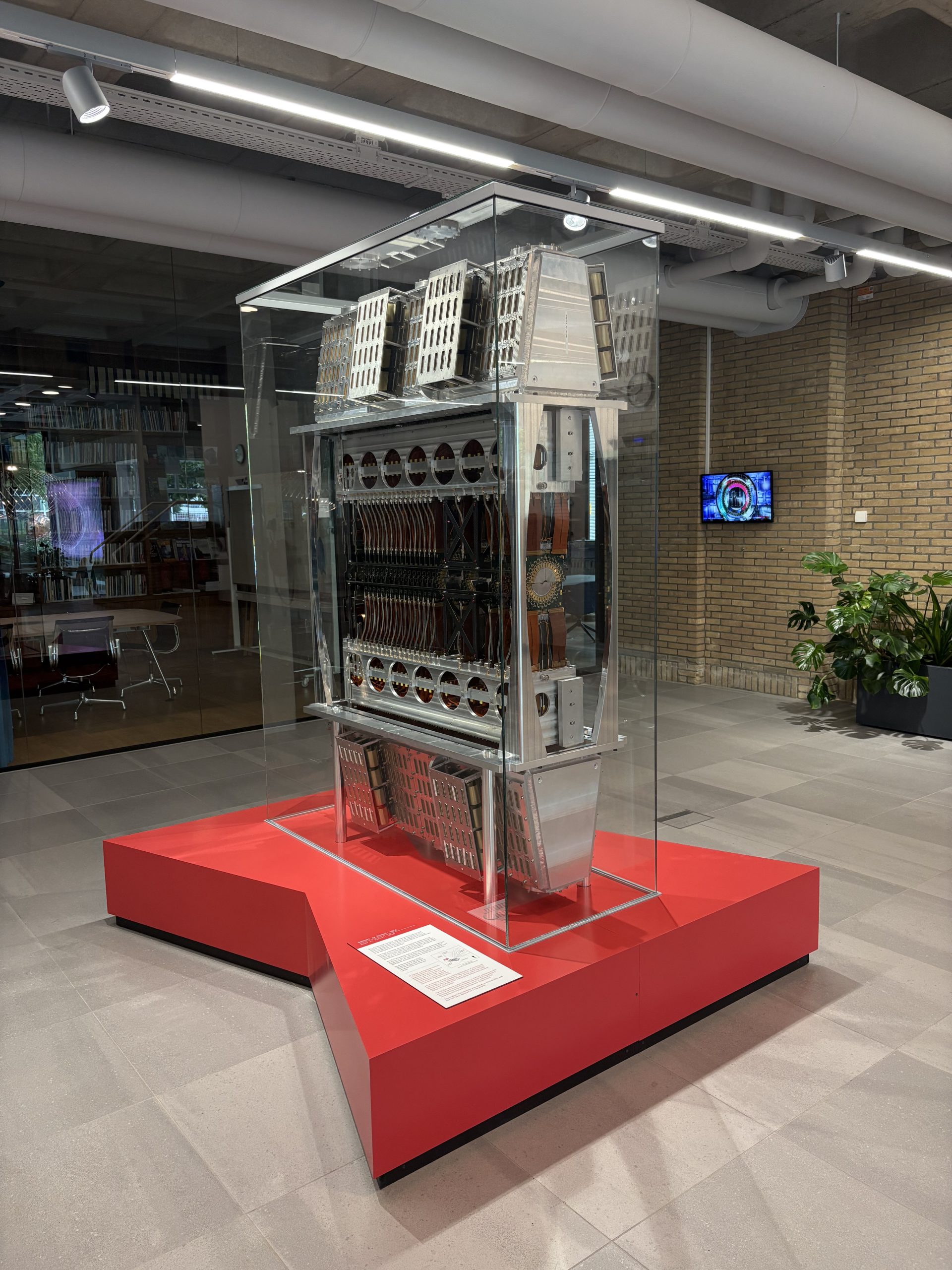
Made at Nikhef: VELO
At Nikhef, the National Institute for Subatomic Physics, groundbreaking innovations in science and technology are combined. In this way, Nikhef contributes to world-leading instruments, experiments and discoveries in particle physics.
A fine example of this successful combination of science and technology is the VELO detector. This Vertex Locator, built by Nikhef and other institutes, plays a central role in the LHCb experiment at CERN, which investigates differences between matter and antimatter.
VELO localises proton collisions in the LHC accelerator with micrometre precision. This allows the exact starting points of particle tracks to be determined, which is necessary for observing and analysing particles and antiparticles.
This original VELO detector was used from 2010 to 2018, and has now been replaced by a new version.