Theme 2
Particles and forces
All atoms and molecules in the matter around us are composed of only a few elementary building blocks.
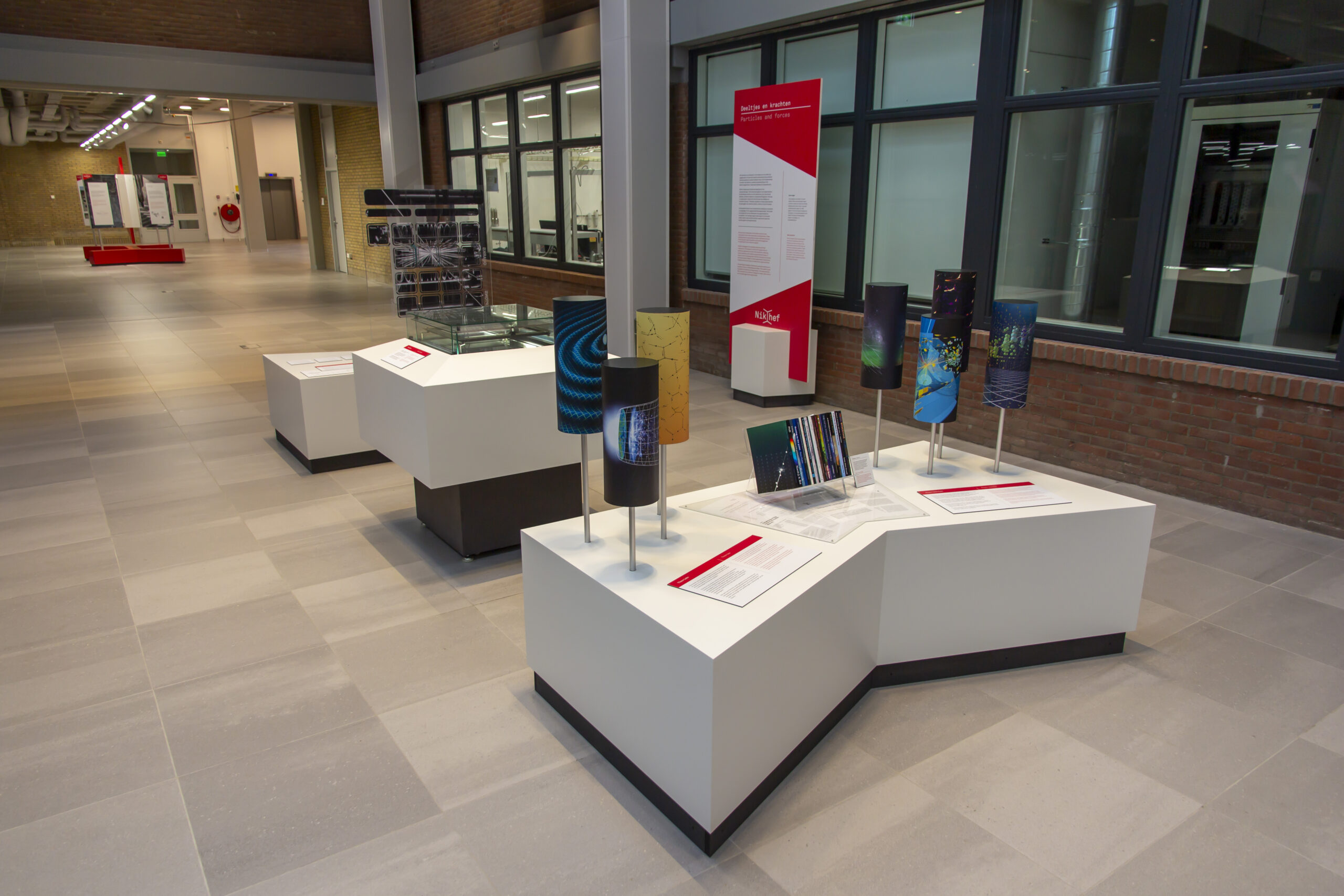
These building blocks are governed by three fundamental forces: the strong and weak interaction and electromagnetism. An additional force of nature is gravity.
Nikhef investigates the smallest particles and their interactions. The research is done with experiments at particle accelerators and with instruments for detecting cosmic particles, dark matter and gravitational waves. It shows in ever-increasing detail how the interplay of particles and forces works. Based on these experiments, theorists try to deduce the rules of play of matter, force, space and time.
The existing knowledge of elementary particles and forces is captured in the so-called Standard Model. The model is used to predict the outcomes of experiments. The measurements then indicate how to refine or change the model, after which it can be tested again with experiments.
From the smallest to the largest
No matter how big the universe is, everything is ultimately made up of elementary particles. Nikhef studies the universe from the smallest to the largest scales.
The smallest known building blocks of matter are smaller than a billionth of a billionth of a metre in size. With experiments at particle accelerators like the LHC at CERN and with other experiments, physicists look up to this scale, and in the future perhaps beyond it.
On the other hand, the farthest objects in the universe are billions of light years from Earth, more than a million billion times the distance to the Moon. Current gravitational wave detectors observe colliding objects in the universe that are hundreds of millions of light years away. Future detectors will attempt to look even deeper into the universe.
The Standard Model
Experiments show that the world is composed of a limited number of building blocks, the elementary particles. These particles and their behaviour are theoretically described by the Standard Model. Each particle has numerous fixed properties, such as mass, charge and spin.
Matter is composed of quarks and leptons, of which three generations have been found to exist. Interactions between particles are transmitted through bosons. These are special particles that carry the strong and weak force and electromagnetism. The Standard Model has twelve quarks and leptons, plus their antiparticles. In addition, there are five types of bosons, among which the Higgs boson that explains how particles can have mass.
The masses of the particles vary widely. Neutrinos are feather light, whereas a top quark weighs about as much as a whole gold atom. Heavy particles tend to be unstable and easily decay into lighter particles, which can be observed with detectors.
Theories
Theoretical physicists use their minds, pen, paper and computers to try to capture the properties and behaviour of the smallest particles, space and time ever more precisely using mathematical formulas and models.
Space and time are described by the theory of relativity while our current knowledge of elementary particles is summarized in the so-called Standard Model. In this quantum theory, particles are not objects, but expressions of fields on the very smallest scales. The model is mathematical and complicated, but can also be summarized in a few formulas.
The work of theorists is used to predict the outcomes of existing or new particle experiments. In turn, the results of experiments give theorists clues for improvements and extensions of the theory.
Experiments
Centuries of experimental research have shown that matter consists of particles. With the advent of particle accelerators in the 20th century, it became possible to study the fundamental properties of these particles themselves, for example at CERN near Geneva.
When particles are fired at each other at high energies, they get so close together that fundamental laws of nature come into play. Detectors record these collisions. From the tracks,experimental physicists reconstruct how the interactions have unfolded and what exactly may have happened.
Other detectors in astroparticle physics observe cosmic particles, search for dark matter, or measure vibrations of space and time called gravitational waves.
All these experiments show whether there may be unknown phenomena at work, for which theories need to be refined or improved.