Theme 4
Signals from the cosmos
Particles sometimes strike the earth and atmosphere with enormous energy, or, on the contrary, fly through it almost unhindered.
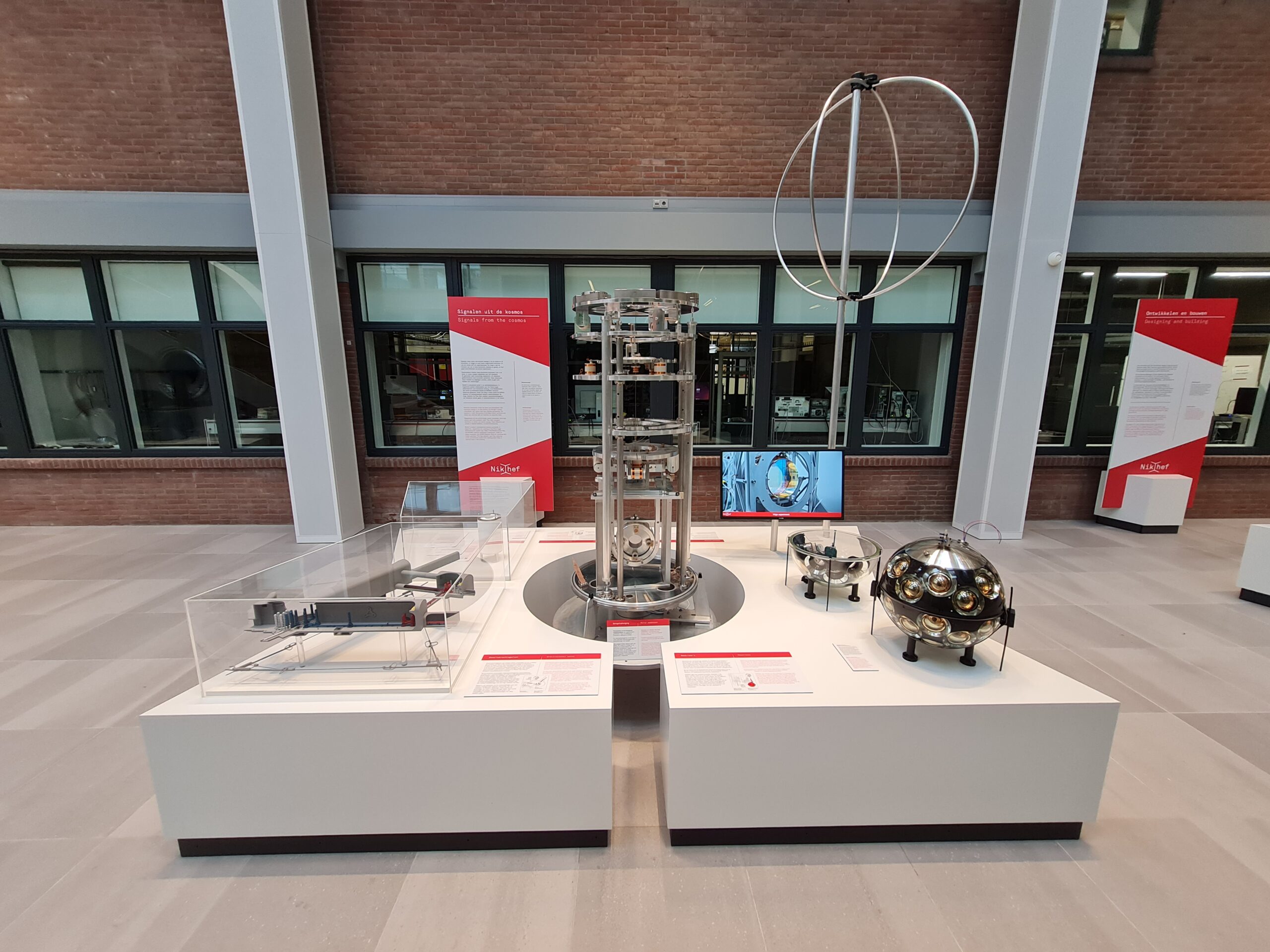
And space itself also vibrates perceptibly. The question is what the sources of all these cosmic particles and waves are, and how well our theories can describe them.
Researchers do not control these cosmic processes, and must simply wait what presents itself. They often use giant detectors, to notice rare events anyway. These detectors are usually in remote locations, to avoid disturbances.
Nikhef is active in astroparticle physics worldwide. In Argentina, researchers are working on the Pierre Auger Observatory for cosmic rays. Deep in the Mediterranean Sea, the KM3NeT neutrino telescope is being built. Under an Italian mountain, the XENON detector waits for incoming dark matter particles. The Virgo detector near Pisa measures subtle gravitational waves from colliding black holes or neutron stars in the universe.
On display on this island
Gravitational Waves
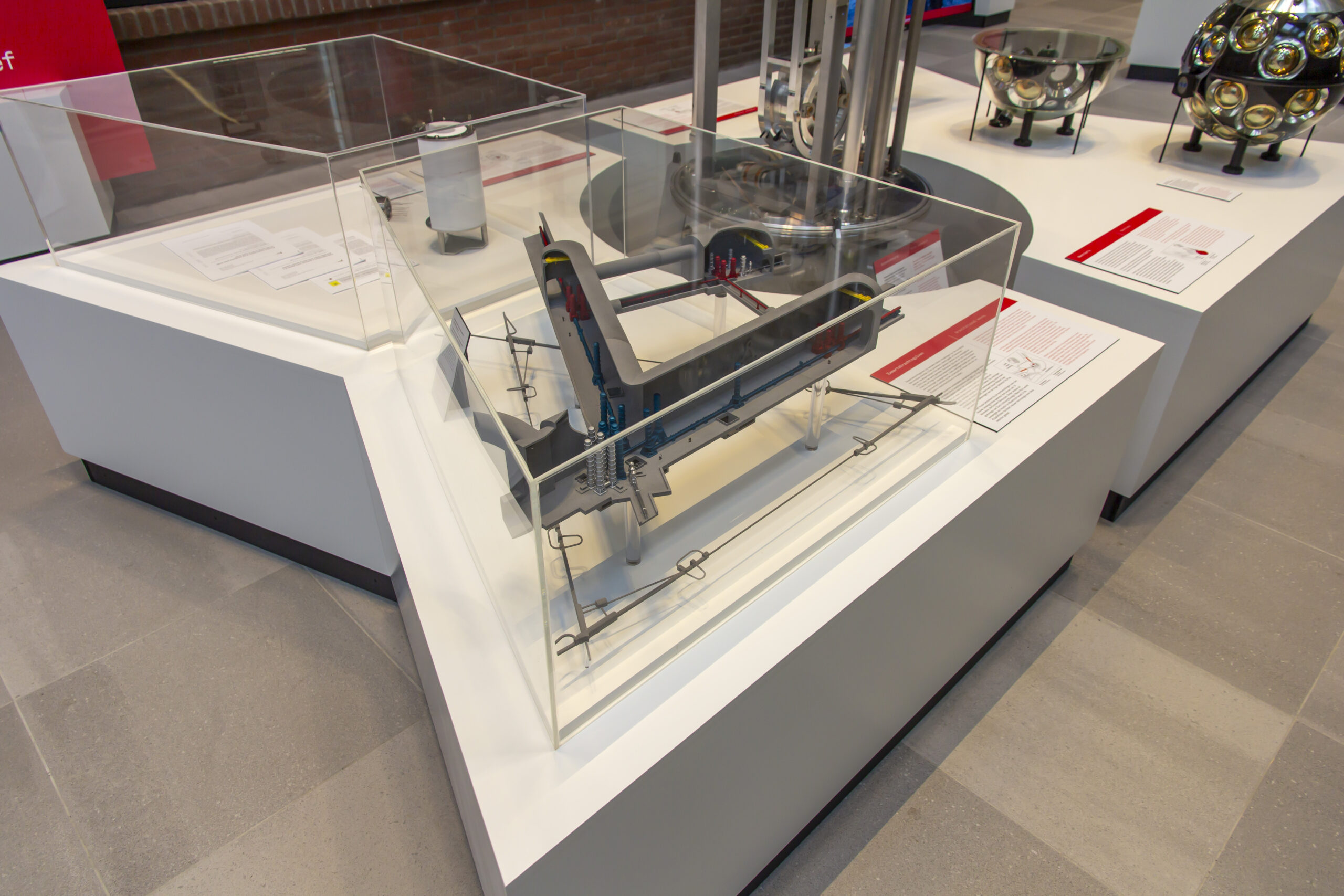
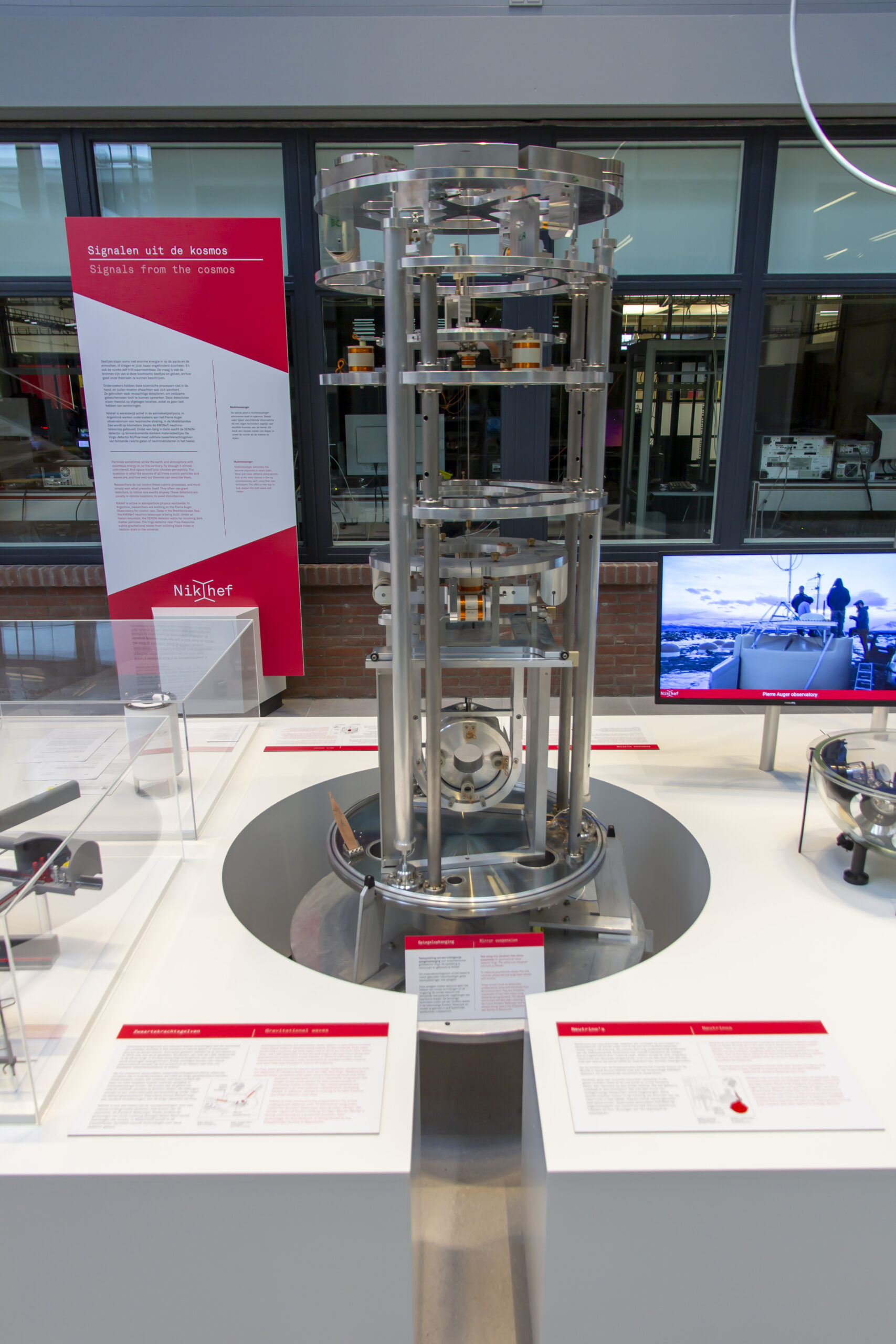
Gravitational waves are extremely small ripples in spacetime created when black holes or neutron stars collide in the universe. They were predicted a century ago and measured in 2015 for the first time. Since then, the LIGO detectors in the US and Virgo in Europe have observed gravitational waves from many dozens of distant collisions. Such measurements provide a new astronomical window on the universe and also help test Einstein’s theory of relativity.
As they pass, gravitational waves cause small distance variations that are detected in interferometers such as LIGO and Virgo. Researchers measure those variations with laser beams bouncing back and forth between motionless mirrors in kilometre-long arms. The length of the arms allows for the measurement of extremely subtle variations. The measurements are analysed in an international collaboration including Nikhef. In addition, Nikhef is helping to further improve the Virgo detector near Pisa.
Nikhef is also involved in the preparations for a new underground detector with 10 kilometres long arms called the Einstein Telescope. Among other places, the border region of South Limburg (Euregio Meuse-Rhine) is being considered as a potential location. New technology for this detector is being tested at the ETpathfinder facility in Maastricht.
Dark Matter
As it turns out, the universe is not only filled with visible stars and galaxies. About 85 percent of the matter that causes gravity do not emit light and is therefore invisible. Physicists think this points to new, as yet unknown particles with only rare interaction with ordinary matter, called dark matter.
The XENON detector under the Gran Sasso mountains in Italy attempts to observe dark matter with a large vessel of pure liquid xenon. Billions of particles of dark matter should pass freely through the liquid every second. But on rare occasions, a dark matter particle might still hit a xenon atom. Such a collision causes a flash of light in the detector, plus moving electrons that generate a second flash of light further away.
Deep under the mountains, the XENON experiment is shielded from interfering influences. Nikhef is intensively involved in XENON. So far, no dark matter particles have been observed, but it takes years of patience to collect enough data for a possible discovery.
Cosmic Rays
Earth is constantly bombarded by particles from the universe. What their sources are is not well known. Sometimes these particles have extremely high energy. Their impact in the atmosphere causes avalanches of other particles, which can be observed from the Earth’s surface. These cosmic rays offer physicists a different way of looking at particle processes than with accelerators on Earth.
The Pierre Auger Observatory studies cosmic rays in the pampa in Argentina. Nikhef is a participant in the project and is helping to build improvements and extensions to the detectors.
The observatory consists of many hundreds of water-filled tanks spread across an area the size of the province of Utrecht. These tanks observe the particle avalanches in the atmosphere. Antennas and telescopes help to further map them.
Neutrinos
Neutrinos are ghostly particles created by processes in atomic nuclei, both on Earth as well as in the Sun and in other more distant cosmic objects. They are still an enigmatic part of the particle world. Neutrinos are virtually massless and fly mostly unhindered through matter. Out of the many billions of neutrinos passing by every second, one only occasionally collides with an atom on Earth and can therefore be observed.
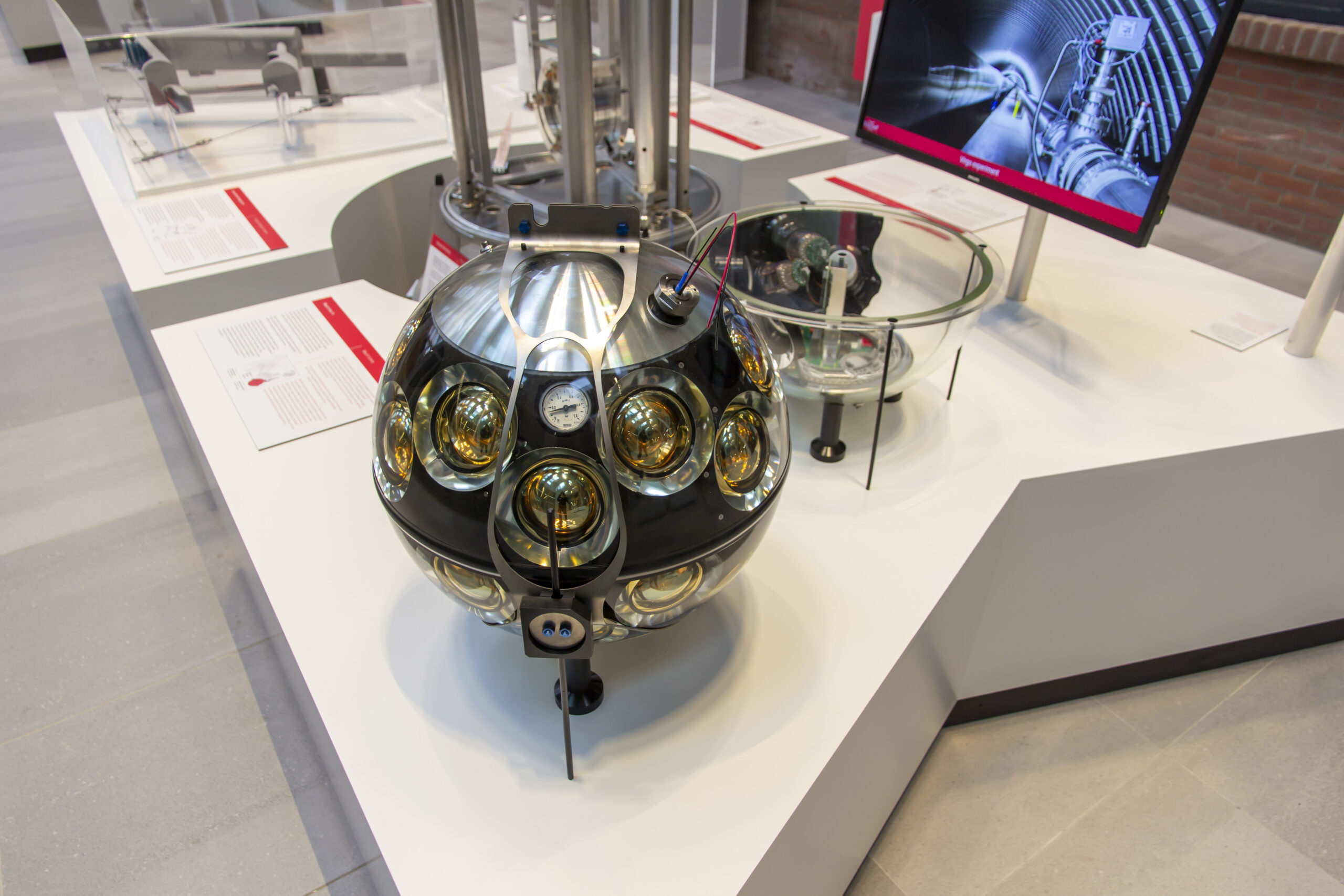
At the bottom of the Mediterranean Sea near Toulon in France and near Sicily in Italy, Nikhef is helping to build the giant KM3NeT detector to observe passing neutrinos.
KM3NeT will monitor a cubic kilometre of seawater. Very occasionally, a neutrino collides with another particle in the dark water. When that happens, it creates a trail of light that is captured using a forest of light-sensitive phototubes. These tracks can point in the direction of sources of the neutrinos in the universe. This involves collaboration with astronomers. In addition, KM3NeT studies the properties of neutrinos themselves, such as their masses and their ability to change identity.