Theme 5
Designing and building
Particle physics research requires advanced technology.
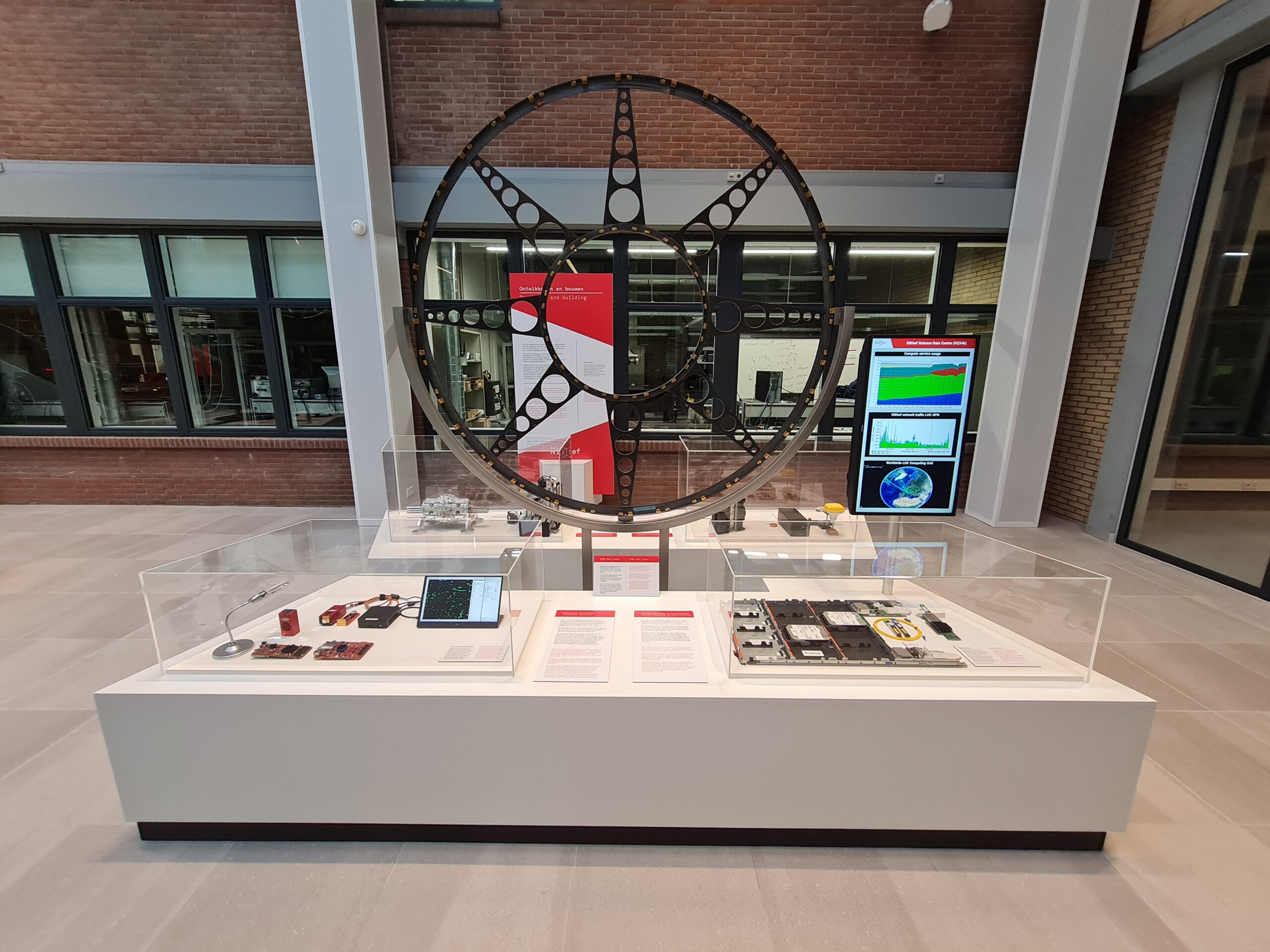
Often this has yet to be developed. Nikhef has a long tradition of designing and building the necessary technology for large experiments.
The technical departments are thereby an essential part of the institute. Their work gives Nikhef scientists a solid entry into international projects and collaborations in particle, astroparticle and gravitational wave research.
Amsterdam is home to three large technical departments of Nikhef: Mechanical Technology, Electronics Technology and Computer Technology. In addition, Nikhef has departments for Detector R&D and Physics Data Processing. There are workshops, laboratories, design and server rooms. Nikhef also houses and manages one of the major data exchanges in the network that connects researchers to experimental data at CERN, among others.
Computer Technology and Data Processing
The analysis of particle tracks begins with the collection of often enormous amounts of data in experiments. Nikhef has traditionally been a pioneer in storing and distributing this kind of data, as well as in analysing it.
The Computer Technology (CT) and Physics Data Processing (PDP) departments work on advanced technology for this purpose. In many projects Nikhef internationally plays a leading role. In doing so, it always keeps its eye on a future with even more data.
Nikhef houses its own large data center in Amsterdam, where servers bring in data from for example CERN, for analysis by scientists. The data center is one of the international hubs for data traffic and computational work in particle physics. In Amsterdam, Nikhef is on Europe’s main internet exchange and has the fastest data connections in Europe.
Electronics Technology
Detectors are built to make particles visible. In almost all cases, this is done with charge-sensitive or light sensors,which give off an electrical charge when a particle passes. This charge is converted into detector signals with electronics. These are then digitalised so that computers can process them.
Nikhef has a large Electronics Technology (ET) department. It designs, builds, and tests many prototypes of electronics for processing detector signals into data that scientists can work with.
The electronics needed are often so specific that they must be specially developed. This is done in cooperation with scientists from the experiments and the Detector R&D department, and in international collaboration. The department works with the latest developments in microelectronics. The designed electronics are eventually produced by companies in large numbers for use in the various detectors for particle and astroparticle research.
Detector Research & Development
Detectors are the senses of particle science. By making them even more sensitive, physicists can discover more of the particle world. By definition, detector technology balances on the edge of what is feasible.
Nikhef’s Detector R&D department develops and studies new, even more sensitive sensor techniques and tests their usability in the large experiments at CERN and elsewhere. Increasingly, this involves the use of chip-like sensors made of semiconductors such as silicon. Fast timing, the processing of a flood of signals in even quicker intervals, is becoming increasingly more important. In addition, sensors and detectors must be hardened against, for example, radiation or extremely low temperatures.
Some sensors from particle physics can be applied outside of science, for example in medical imaging. This has led to several spinoff companies.
Mechanical Technology
Particle detectors often require special structures to precisely install and hold all parts and components in place. These structures are often unique in the world.
Nikhef’s Mechanical Technology (MT) department designs and builds custom-made structures for detectors in particle physics. The department consists of a group of specialised designers and instrument makers and has a large, modern workshop at its disposal in Amsterdam. They work closely with scientists and other technical departments and can work with all possible materials and under very strict requirements for dimensions and properties. This is often done in an international context.
The department for example helps build detectors at CERN, the Virgo gravitational wave detector in Pisa, the ETpathfinder gravitational wave detection test lab in Maastricht and detector lines for the KM3NeT neutrino telescope in the Mediterranean Sea.